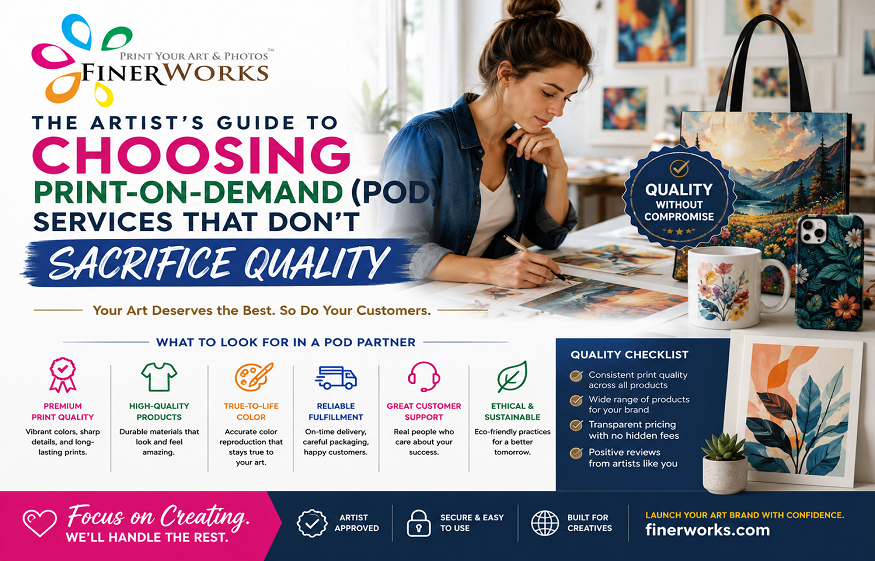
With all the hard work you’ve just put in, you’ve spent hours, and days, or maybe weeks creating a piece of art you love. Now we have the next hurdle… How do you get it onto a print that you would be happy for people to display on their walls?
That’s where things can get a bit tricky for a lot of artists.
An explosion of print on demand companies for artists has made selling images as easy as can be. Upload a file, link your online shop, and someone else will do all the printing and shipping. That sounds ideal until the print arrives dull and muted, the paper feels cheap and nasty, or there’s little resemblance between the final print and the one the customer ordered.
There is nothing more important than quality. It is on your reputation.
When you’re shopping for an artist-focused print on demand sites for artists, don’t be swayed by flashy commercials or the lowest prices. Ask the simple question: Does this printing really look like my art?
Let’s dive a little deeper and find out what really counts.
Why do so many artists outgrow generic print-on-demand platforms?
A trend is emerging more and more obvious. Google Trends has been showing that searches for “print on demand companies for artists,” “art prints on demand,” and how to convert your art into prints are still on the rise as more independent artists establish their online enterprises.
Here’s the snag.
Most of the mainstream POD providers started off printing T-shirts, mugs, phone covers, and novelties—they are used to selling things like that. Fine art printing is just another product category to them.
That causes a gap.
Artists usually care about:
- Accurate color reproduction
- Archival materials
- Museum-quality papers
- Premium packaging
- Collector-worthy presentation
General POD firms tend to be volume-oriented. Asking fine art firms to operate at this volumic level seems impractical.
Which are exactly why artists are finding more and more that they prefer to take the subject of print on demand into the realm of specialized print on demand services for artists who concentrate on gallery-quality printing, not mass production.
What should you actually compare besides price?
Cheap to produce, expensive in the long run. Instead of simply comparing the prices, compare the providers through attributes that affect the customer’s experience directly.
Begin with color fidelity: The professional giclée print is printed with pigment inks that are designed to produce darker blacks, more seamless gradation, and richer colors than many off-the-shelf printing options. FinerWorks, for example, will use professional Epson UltraChrome, Canon LUCIA pigment inks, and museum-grade paper that is intended for archival quality reproduction.
- Look at paper choice: Different works of art require various types of paper. It is often preferred to use textured papers for watercolors, charcoal sketches, photography, or digital painting.
- Think about durability: As far as artists and buyers are concerned, collectors want art prints on demand that won’t fade in a few months but will last for several years. Archival paper and inks will safeguard your art and your reputation.
- Check the quality of fulfillment: Packaging, shipping consistency, and production reliability all become part of your customer experience, even if you never actually touch the finished product.
Which print-on-demand features matter most for growing artists?
A lot of artists find out that printing isn’t even the hardest part after a while. What is a part of it? Sharing and setting up each file for each purchase becomes overwhelming as your business expands.
This is the point where effective, artist-specific print on demand services for artists start to stand out from the crowd.
Implementing a print platform such as FinerWorks is useful—using Virtual Inventory, artists can store print products that have already been preconfigured and assigned with SKUs. These products can be synced with Shopify, Etsy, WooCommerce, and Squarespace, reducing fulfillment costs and maintaining a consistent product while using custom-branded dropshipping that promotes your brand instead of the printer’s.
These operational efficiency details are rarely in the marketing headlines—yet they save so much time in the week.
Read More: Walk Where Dreams Breathe: Four Nepal Treks That Change Your Life Forever
What should you look for to know that a POD service can give you museum-quality work?
Marketing slogans are very easy to write. The proof becomes more difficult. Professional fine art printers usually provide:
- Archival pigment inks
- Museum-grade paper options
- Calibrated color workflows
- Detailed print previews
- Multiple fine art substrates
- Framing options
- Sample ordering
One good tip from many seasoned artists is to order sample prints before you start selling collections.
All of this advice is repeated time and again in community discussions on artist forums. Creators will evaluate actual print samples from various providers, not just product shots, before settling on the POD platform that best suits their artwork. While a few individual artists mention certain specialized print labs yield more detailed, vibrant results than broader POD marketplaces at a higher price point, the main takeaway remains: trust your own eyes before trusting any sales page.
How do you go about transforming your artwork into prints that will get customers recommending them?
Since you’re looking for information on how to turn your art into prints, realize that digitizing your artwork shouldn’t be the final, rushed step. Consider this a core part of your creative process.
A few practical habits make a noticeable difference:
Calibrate your monitor whenever you can.
Export files to a high resolution.
Don’t forget to set the correct aspect ratio so your image doesn’t get awkwardly cropped.
How to troubleshoot test prints and prove your new collection:
Produce side-by-side comparisons of different kinds of paper applied to the same piece of work.
See every print in ambient light first before making long-term choices.
Pro printers make artists proof their work for this reason; conversion values from screens don’t often translate exactly when printed. You may discover that by testing various substrates you get a dramatic increase in depth, texture, and color quality. These subtle nuances differentiate a decent print from a “wow” piece that keeps your clients talking.
Read More: Earnings Growth Trajectories and Their Role in Rewarding Shareholders
Frequently Asked Questions
What is the best print on demand sites for artists?
Which platform qualifies among the best print on demand sites for artists really depends on what you value. If you’re focused on museum-quality printing, archival materials, and professional fulfillment, seek out niche sites that produce fine art prints rather than mass-market merchandise.
What is the difference between standard printing and giclée printing?
Giclée technology employs high-resolution printers with archival pigment-based inks and top-quality fine art paper, producing superbly accurate color, detail, and long-lasting images compared to standard commercial printing.
Is print on demand profitable for artists?
Yes. Because products are made to order, the artist minimizes financial risk while offering single or multiple size options. Profitability will be dictated primarily by your retail pricing, print quality, and the overall customer experience.
Should artists order samples before selling?
Yes. Ordering a sample print allows you to check for color correctness, paper feel, sharpness, and packaging quality prior to a customer placing an official order.
Can print-on-demand services integrate with online stores?
Most professional dropship providers are compatible with popular e-commerce platforms such as Shopify, Etsy, WooCommerce, and Squarespace, making seamless order fulfillment and branded dropshipping possible.
Conclusion:
With so many print on demand companies for artists available, you have more options than ever before. However, not all available platforms cater specifically to fine art.
The best print on demand sites for artists don’t just print; they protect and maintain your artistic vision with faithful color, archival papers, reliable fulfillment, and professional presentation. If you’re selling art that dedicated collectors will proudly hang on their walls for years to come, choosing quality—even at a higher cost—is not an expense. It’s an investment in your name, your brand, and every upcoming sale.